

One of the trends that the COVID-19 crisis has most clearly accelerated is that of digital transformation (DX). This dramatic shift has the potential to bring efficiencies to the operations of companies and organisations, and deliver a vast range of benefits to people’s lives. However, digital divides still exist, and regional communities often don’t have the tools required for DX at the same level that big cities do.
According to a study by the International Telecommunication Union (ITU), in urban areas globally, 76% of people were connected to the internet in 2020, compared to 39% in rural areas.
Japan has positioned DX as a vital element of its strategies for a virtuous cycle of growth and distribution, driven by the ambitious goal of Prime Minister Kishida Fumio to create a ‘New Form of Capitalism’, which will be both people and sustainability-focused.

One of the new key policy pillars is the Vision for a Digital Garden City Nation for Achieving Rural-Urban Digital Integration and Transformation across Japan. This will include measures, many developed through public-private partnerships, to strengthen nationwide digital infrastructure, deliver new digital services, and train and secure tech-savvy personnel, including digitalisation supporters who will work to ensure everyone enjoys the benefits of digitalisation.

A few hours west of Tokyo in a picturesque valley in mountainous Nagano Prefecture, sits the small, charming city of Ina.
It is a municipality like many in rural Japan in the sense that it is sparsely populated by residents whose average age is increasing annually.

Ina city has been proactively working on rural DX, with the local government in partnership with private enterprises delivering services such as ‘shopping’, ‘transportation’ and ‘medical care’ to remote locations. “As the population ages, with one in three people over the age of 75, many are unable to drive and an increasing number of people are finding it difficult to go shopping or to medical facilities,” explains YASUE Akira, Ina City’s Chief of New Industrial Technology Promotion, Policy Planning Division. “So we decided three years ago that MaaS [mobility as a service], which combines the convenience of a car with the efficiency of public transport, would be the best way to solve our problems.”

The city replaced its loss-making local bus service with an on-demand MaaS solution in collaboration with a venture company from a local university, utilising AI to rapidly dispatch transportation for residents. Following similar principles, in April 2020 the city introduced a ‘mobile clinic’ to provide medical services for older residents to the community via a special vehicle for online consultation, developed in conjunction with a joint venture established by Toyota Motor Corporation and SoftBank.

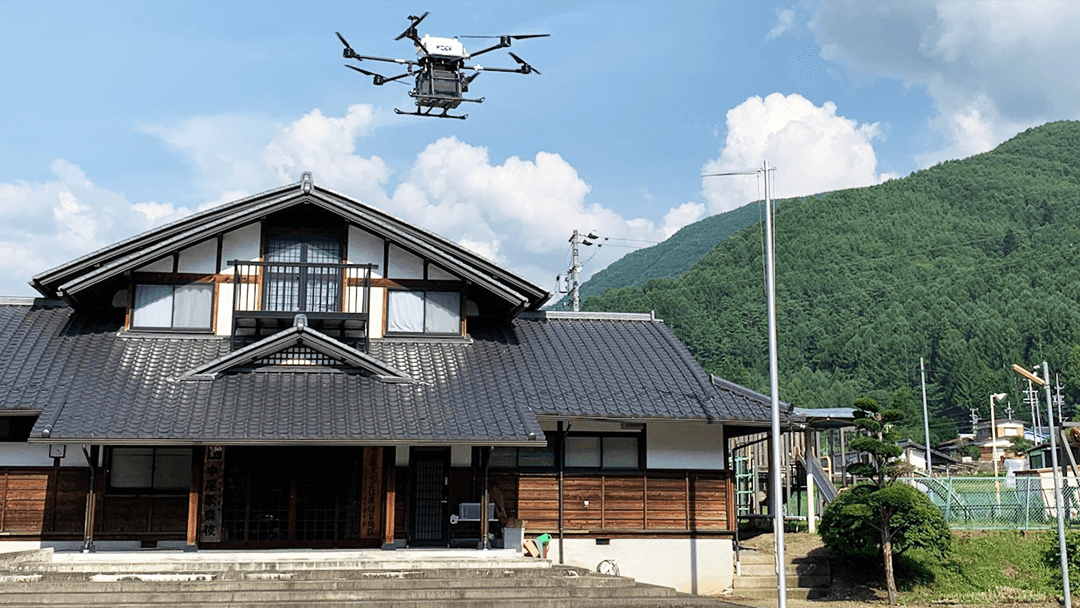
Then in August 2020, Ina City launched a ‘Mutual Support Shopping Service’, Japan’s first delivery service using drones to transport shopping to residents who pay a monthly subscription fee.
The aging population means there are more people experiencing difficulties with shopping.
The service, created in partnership with telecoms firm KDDI Corp, is provided through cable TV. Customers can place orders using the TV remote control and make payments through their cable bill. The MaaS transportation can also be summoned via cable TV, which has almost 100% penetration in the area because the city provides it to residents due to poor signal reception for regular television broadcasts caused by the mountainous terrain. If shopping orders are placed in the morning, then deliveries are made the same day, and drone flights are now a regular sight for the city’s residents. They can currently fly for 10km carrying loads of up to 5kg and land within a few dozen centimetres of their target, and the research is ongoing to increase the maximum range and payload. The local government is looking into expanding the range of goods that can be carried as well as other uses for the drones.
The significance of Ina City’s drone delivery service implementation, especially for the population in the remote mountainous region, is not only the advanced level of technology, but also that it was deployed in the manner most suited to the issues and conditions that the local community was facing.
“The combination of KDDI’s smart drone platform, and the use of local resources allowed us to overcome the issues the community was facing. In mountainous areas, cable TV and optical fibre are being installed under government initiatives, so this platform could spur as a good model for other cities with the same issues,” ventures TACHIIWA Masayuki, manager at KDDI’s Business Exploration & Development Division.
“Generally, drones rely on local wireless networks, but this restricts the distance that can be flown,” explains Tachiiwa. “As a mobile telecoms provider, we are able to utilise our mobile network, making autonomous flying over longer distances possible, even over mountainous terrain. However, our priority is to have our technology used in a system that the community can manage on its own in the safest possible way.”
“Even in terms of the delivery, technically we could fly the package right to the door, but we know that elderly people living alone, for instance, feel safer with the last one mile delivery by a caretaker, which also allows the city to deploy human resources where they are most needed,” adds Tachiiwa.
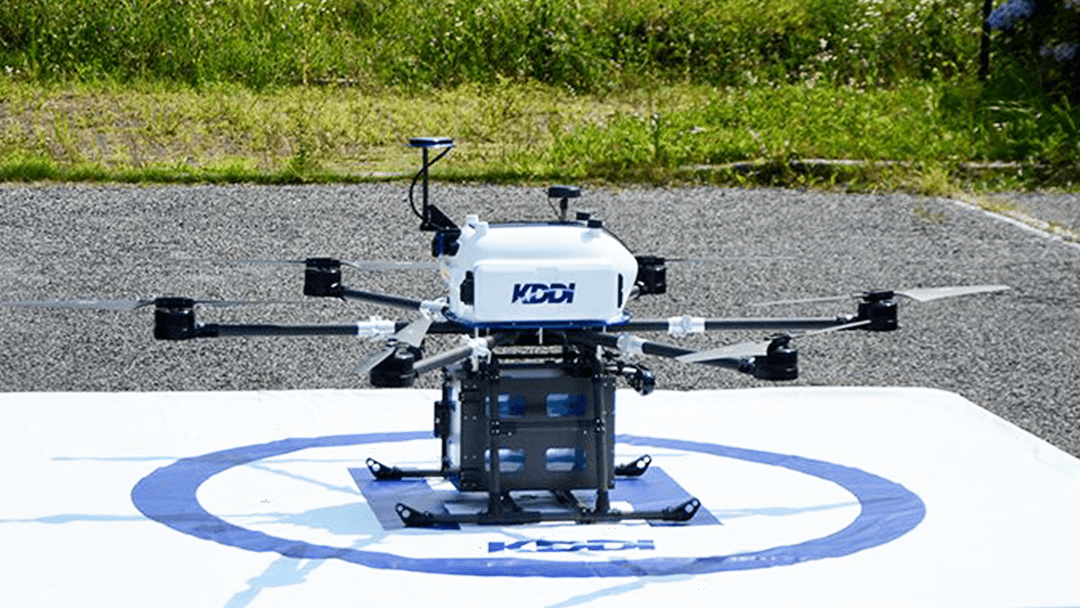
Flying usually five days a week for more than a year, the drones have operated without a single incident. Out of safety concerns, they haven’t yet flown on days of heavy snow or rain, though there are plans to do so in the future.
For areas where cable TV is not as widespread, KDDI is looking at running the service via smartphones or tablets. Tachiiwa suggests that once 5G and even 6G networks come online, the potential for drones will expand further, into applications such as measuring and inspecting renewable energy facilities.
HIRONO Masafumi, group leader at KDDI’s Business Exploration & Development Division believes that 5G can help “revitalise local areas, promote digital human resource development and create an inclusive society where everyone can enjoy the benefits of DX.”