Fukushima’s future built on green energy
The Great East Japan Earthquake of March 11th 2011, left vast swathes of coastal areas of north-east Japan, including Fukushima Prefecture, scoured flat by the tremor and the tsunami that it triggered.
With a magnitude of 9 - the largest ever recorded in Japan - the quake caused billions in damage and wrecked communities across much of the eastern Japan’s coastline. The human tragedy was even worse, with more than 20,000 people dead or missing.
A decade on from the disaster, the people of the region have made great strides in rebuilding their lives and, with the assistance and support of the government and from Japan’s friends abroad, towns and livelihoods are steadily being restored.
Some particularly forward-looking municipalities have chosen to look at the tragedy that befell them as an opportunity and have radically rethought the very foundations of their communities.
For many, the key to a prosperous and resilient future is energy that is locally produced and locally consumed – and can therefore be relied on even in the event of another major disaster. To achieve the better future, they have partnered with private companies and both the local and national governments in initiatives such as the Fukushima Future-Oriented Project.
Naraha Town rebuilds
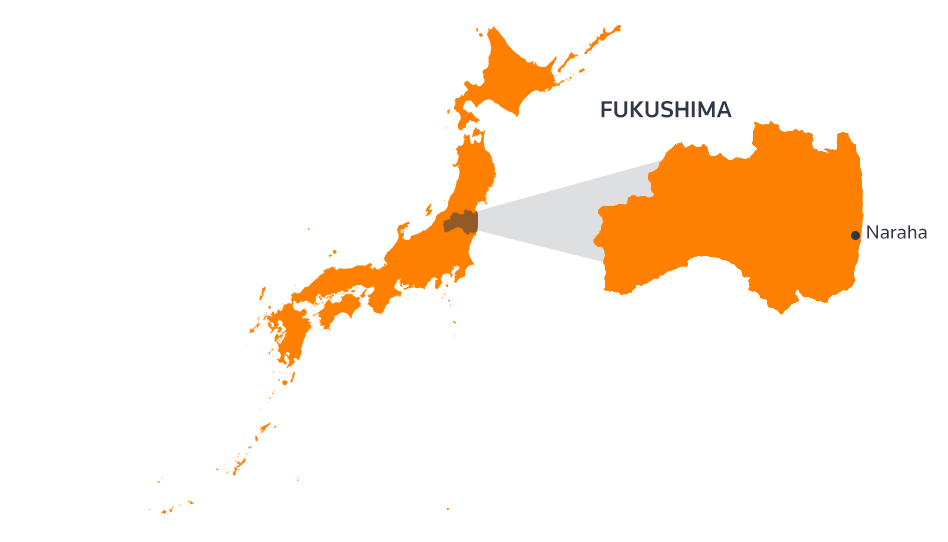
The earthquake was by far the most powerful that ENDO Toshiyuki, General Manager of Naraha Town Reconstruction Promotion Division, Town Promotion Unit, had ever experienced, he said.
The impact was so strong and the shaking from the earthquake seemed to go on for such a long time, and then, about 40 minutes later, the tsunami struck.
Thirteen residents of the coastal town of Naraha died when the 10-meter wave hit, with around 125 homes and other buildings destroyed. Inhabitants were also forced to leave their homes due to the danger of radiation released by the accident of TEPCO Fukushima Dai-ichi Nuclear Power Plants, which is 20km away from the town.
Yet the community has demonstrated its determination to rebuild. Endo said,
The people love their town and even though we had to evacuate, virtually everyone always said they wanted to come back again.
The town was entirely evacuated after the disaster, but as of January 2021, it was once again home to 4,030 people, which is more than 60 percent of the population before the disaster.
Guaranteeing a reliable supply of energy to help keep residents warm, fed and sheltered in the event of another disaster was also recognized as a critical requirement of the resurgent town. A key part of that, says SAKAMOTO Hiroshi, Manager of Naraha Town Reconstruction Promotion Division, Town Promotion Unit, is adopting renewable energy.
“Because of our experiences from the Great East Japan Earthquake and the nuclear disaster, people decided that they wanted the town to consider alternative energy sources that would withstand a disaster better,” he said.
“And I think that is the same across Japan as people realize that they should not rely on one source, but diversify and disperse their supplies of power and create interconnected and resilient communities.”
The people of Naraha are demonstrating that philosophy through the construction of the Emi Furu Town Naraha, a hub of around 140 homes centered on a commercial facility and a community center.
And it is entirely powered by a solar energy system that creates 1mW of energy, with up to 600kW of power stored on site in batteries – a critical addition to the system as a reservoir of power that further guarantees the community’s resilience.
In addition, a centralized monitoring system links the newly built community and tracks precisely how much energy is being generated and how much is being consumed. An added benefit of the system, Sakamoto said, is that unusual consumption patterns become apparent, such as if a resident is incapacitated, they can be helped out accordingly.
“Before, we used to pay for electricity from outside the town, but now we are generating it in the town and supporting ourselves and our economy,” said Sakamoto, adding that even the solar panels that have been positioned on the roofs of the Emi Furu Town Naraha were fabricated in a factory in the town.

Residents of Naraha who experienced the 2011 disaster say the guarantee offered today by locally generated solar power “is a great source of reassurance and comfort” should another emergency arise.
Many residents have been motivated to adopt solar energy as their chance to do something to help the environment.
They are aware that by shifting to a renewable energy source, they are assisting in the drive to achieve a low-carbon society – and that will assist future generations to better resist climate change.
They also hope their experiences might encourage other communities to consider turning to local, renewable sources of energy - with Endo adding that some of the town’s residents who are not presently connected to the system have already expressed hope that it might be expanded in the not-too-distant future.
A broader, future-oriented community

In the aftermath of the 2011 tragedy, the national government teamed up with experts, local communities, and private companies to draw up a future vision of Fukushima.
A number of these initiatives coalesced with the signing in August 2020 of an agreement between the Ministry of the Environment (MOE) and the prefecture on forward-looking environmental measures to help rebuild Fukushima.
According to MOE, the wide-ranging agreement covers the reconstruction of the prefecture and its communities by encouraging independent renewable energy systems and promoting decarbonized towns and villages.
The prefecture and the ministry are also committed to promoting and assisting firms operating in the environment-friendly recycling sphere and utilizing the attraction of natural resources - such as the prefecture’s stunning national parks - to attract more visitors. NORIHISA Masashi, Counselor of Environmental Regeneration and Material Cycles Bureau, Ministry of the Environment, said
Fukushima Prefecture is promoting policies designed to make it a pioneer in renewable energies, while the national government also considers these alternative energy sources to be critical to both local reconstruction efforts and working to solve the problem of climate change.
In March 2012, exactly one year after the disaster, the local government set itself a target of generating more than 100 percent of the prefecture’s power from renewable sources by around 2040. In fiscal 2019, that figure had already reached 34.7 percent.
The national and local governments also anticipate that the collaboration will contribute positively to a post-coronavirus society that is interconnected and resilient to natural disasters and health challenges. Another key component of the agreement is the dissemination of information about the reconstruction of the prefecture and eliminating misconceptions about the region.
Proving ground for a green energy future
The tragedy that affected the people of Fukushima Prefecture so dramatically in the spring of 2011 can never be forgotten. But local residents and the government are determined that something positive should come from the disaster.
Today, this part of Japan has been transformed into a proving ground for renewable energies and other technologies designed to help ease the pressures on the global environment, all the while helping residents to rebuild their lives and communities.
Almost 10 years after the most destructive earthquake in Japan’s history, the government of Japan announced that it would prioritize new forms of environment-friendly energy and realize a carbon-neutral, decarbonized society by 2050. As it rebuilds from the past, Fukushima Prefecture is in the forefront of the nation’s ambitious campaign to reach that target.