Published: September 17, 2023 / Updated undefined ago
IN THE FIGHT TO END SMOKING, MORE MUST BE DONE


Author: Jacek Olczak, Chief Executive Officer, Philip Morris International
For decades, governments and organizations have done everything they can think of to discourage people from smoking. Restrictive regulations. Steep prices. Marketing bans. Public health campaigns.
And yet...worldwide, an estimated one billion people still smoke today.
Let's change that.
It's time to try a more inclusive and innovative approach that's proven in several countries and has the potential to significantly accelerate a decline in smoking and associated diseases...and not by a little, by a lot.
For adults who would otherwise continue to smoke, switching to a smoke-free product is a pragmatic option that can have a positive impact on both individual and public health.
Let there be no mistake. People who have quit or never used tobacco or nicotine, especially minors, should not use these products. And there is no doubt that quitting altogether is the best choice.
But what about the millions of adult smokers who choose not to quit? Today, thanks to smoke-free products, these people have better options than continuing to smoke.
Because of these options, we can begin to imagine a future, a near future, when cigarettes are obsolete.
Since 2016, Philip Morris International has fully committed to moving away from cigarettes, the most harmful form of nicotine consumption. We have invested more than 10.5 billion U.S. dollars in developing and commercializing smoke-free products since 2008--which today account for over 35% of our total net revenues.
Today's environment and rhetoric make it easier for governments and regulators to do nothing on smoke-free alternatives. It's perceived as safer for political careers to abstain from the debate completely rather than be seen as siding with us.
But in the end, this is just prolonging the life of cigarettes and risks shortening the lives of those who use them. For smokers today, doing nothing is not a neutral position. It's a choice with real-world outcomes.
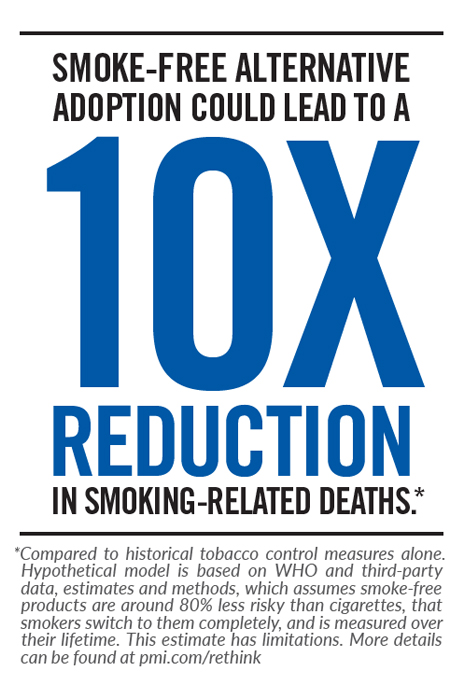
Using third-party data, we've estimated that if the world's smokers switched to less harmful, smoke-free products, it could result in a 10-fold reduction in smoking-related deaths compared to historical measures alone.
This estimate begins to show the impact of not doing more. The human impact. But this is not just a hypothetical situation.
Look at the public data in Sweden, a country that today boasts one of the developed world's lowest smoking rates, at around 5%.
There, snus, a noncombustible form of moist tobacco that is placed between the lip and gums, is the most commonly used alternative to cigarettes. According to this data, mortality rates due to tobacco use in Sweden are much, much lower than in European Union countries where snus is banned.
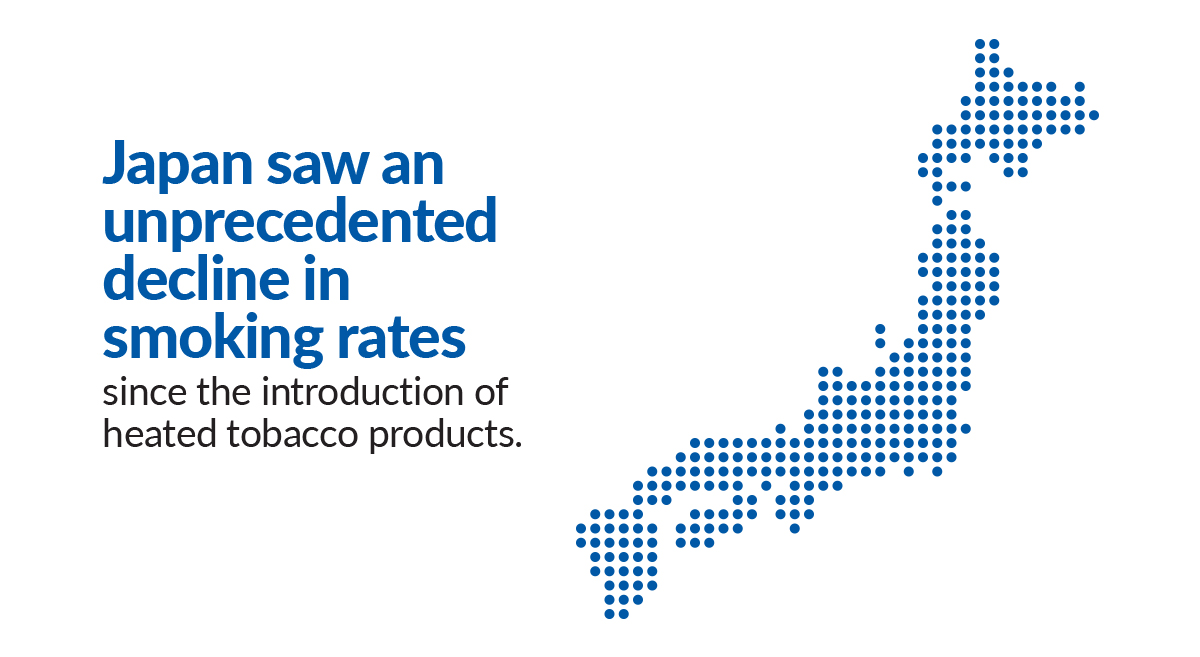
We can also look at Japan, which has seen rapidly declining smoking rates since the introduction of heated tobacco products in 2014. Just like in Sweden, these noncombustible products are beginning to replace cigarettes. Five years after the products were introduced, the Japanese National Health and Nutrition Survey showed an unprecedented decline in the number of adults who smoke cigarettes. More recent studies show that the pace of decline has continued, and today only about 12% of Japanese adults smoke.
Despite all this evidence, the policy of inaction continues in many places--preventing less harmful products from replacing the cigarette.
My question is: Will governments that ban these products or treat them like cigarettes take responsibility for the consequences? Will society stand up and call out the organizations that are blocking progress?
Or will this insanity persist--leaving us with more of the same and millions of people needlessly continuing to smoke?
It is time to center every debate and every decision on the people who pay the price for this failure in regulation.
It's time to work toward a common goal of delivering effective policies that make cigarettes a historical artifact, collecting dust behind glass cases.
We need to remember: Not making an evidence-based decision on smoke-free products today is a decision with consequences for tomorrow.
Some countries are solving the smoking crisis. What do they know that you don’t?
By embracing smoke free alternatives, Sweden now has the lowest male mortality rate due to tobacco compared to other EU countries. Why? In 1992, when the EU banned this far less harmful smoke-free alternative to cigarettes, Sweden retained an exemption from this ban. This was in-keeping with the country’s historical support for this nicotine containing better alternative, which has seen significant use amongst Swedish men since the 1970s.

See the potential reduction in smoking-related deaths in other countries and find out more at PMI.com/Rethink