Japan harnesses offshore wind to power the future
Since becoming prime minister in September 2020, SUGA Yoshihide has made his policy objectives very clear - particularly in the area of green energy.
Japan is committed to implementing measures to combat the devastating impact of global warming on our planet, those proactive policies leading to positive change on industries, economies and societies globally. The ultimate aim, the prime minister insists, is for Japan to play a leading role in the emergence and growth of a green energy industry.
The aim is to reduce Japan’s greenhouse gas emissions to net-zero by the year 2050, with power generated from offshore wind a key component of that plan.
In December 2020, the government announced plans to have renewable energy – including offshore wind - to account for as much as 30-45mkW by 2040, an output equivalent to 30-45 conventional thermal power plants.
The government has earmarked JPY2 trillion ($19.2 billion) in ambitious green energy projects over the next decade. As well as encouraging the development of Japanese technology and helping to preserve the environment, the campaign will serve as a stimulus as the national economy emerges from the coronavirus pandemic.
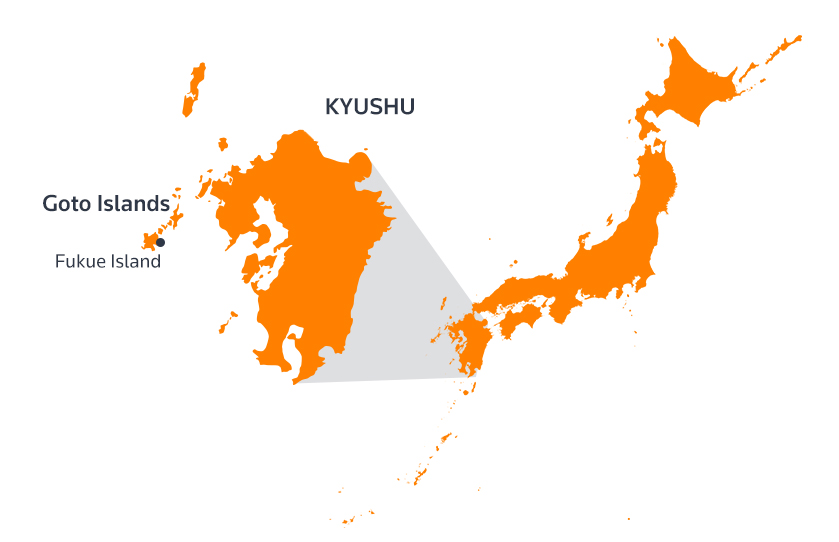
In the Goto Islands, off Kyushu in the south-west of Japan, Toda Corp. is putting the theory into practice with the world’s first floating hybrid wind turbine, where the submerged section of the turbine is made of concrete to provide stabilizing weight and the upper portions are of steel.
Offshore ambitions
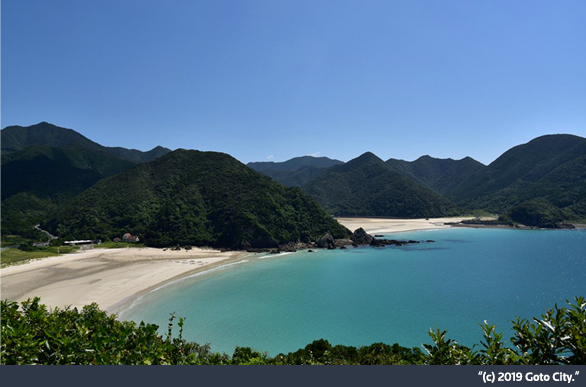
Within sight of Fukue Island, the largest and most populated in the Goto archipelago, a unique wind turbine rotates in the nearly constant sea breezes that affect the region. With 96 meters above the surface of the ocean and a further 76 meters underwater, the 3,400-ton Toda Spar is anchored to the seabed and is the first floating turbine to be a hybrid of concrete and steel.
Toda began work on the turbine in the laboratory as far back as 2007, said Dr. SATO Iku, senior director of the company’s Ocean Renewable Energy Division, with the present equipment operational since 2016 and generating 2,000kW of power for local residents.
“We chose Goto for the project because the climate here is among the harshest in all of Japan because of the frequent typhoons, so we thought that if it worked well here, the turbine could operate almost anywhere in the world,” Sato said.
The turbine has survived the worst that the elements could throw at it, including seventeen-metre waves and wind speeds gusting up to 55.0 meters per second at the height of Typhoon Maysak in September 2020.
The tests have demonstrated that Toda’s plans to provide energy based on the principle of “Three As” - for anyone, anywhere and as you required - have been met, and it has ambitions to work with companies and governments around the world to deploy its technology.
The system has been designed to be flexibly deployed and to meet specific users’ requirements in vastly different environments, while the reduced costs associated with mass production and local implementation are an added attraction.
Closer to home, Toda has determined that offshore wind power has the potential to meet fully 94 percent of Japan’s total energy needs by 2050.
Sato said that from the present single operational turbine, the company is aiming to have 100 units in action by 2025, delivering 1 million kW of energy.
As well as working as a proof-of-concept for its cutting-edge hybrid turbine and powering the local community, Toda has been keen to promote the collaborative elements of the project, including creating employment on the Goto islands.
Toda worked with a small-scale engineering firm on maintenance work, for example, to the point the company is now recognized as a leader in the domestic industry and maintains turbines across Japan.
Onshore advantages
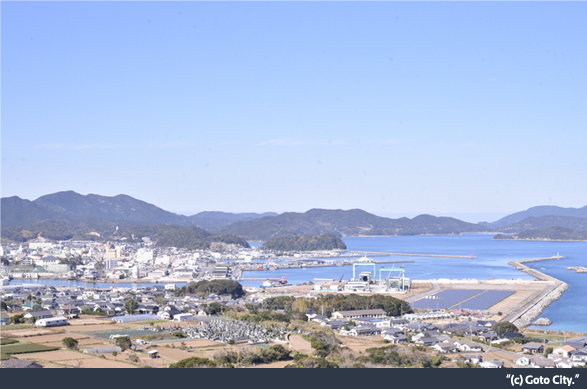
Goto Shimin Electric Power Co. was set up in May 2008 and has quickly grown to supply electricity to 1,300 customers, including the Goto city hall, elementary and junior high schools, local businesses and households. The company uses a number of renewable energy sources, but HASHIMOTO Taketoshi, the firm’s representative director, says he is “proud” his company is utilizing offshore turbine technology.
“Floating wind turbines are a symbol of the introduction of renewable energy in Goto and we are very proud of them,” he said. “We believe it is our mission to make this the main source of the energy we supply.”
The creation of the company has had a knock-on effect, leading to new jobs at subcontractors and other businesses in the community, while there have also been more visitors to the island for training and other related activities.
But arguably the most important development, Hashimoto said, is that the project has increased opportunities to discuss energy and our environment.
KUMAGAWA Chokichi admits that he and the other members of the Fukue Fisheries Cooperative Association had “many concerns about the project” before the turbine started rotating, but they have been won over since.
“We were worried about the impact on the local people, the possibility of fish going elsewhere due to the noise, and harming the local bird population,” said Kumagawa, who is chairman of the association. “But the Ministry of the Environment has collected the data, shared it with us and we have been convinced of the benefits.”
Of particular surprise, he said, is that fish actually appear to be attracted to the floating turbines, making the local fishing grounds more productive.
Today, the fishermen say the project offers the opportunity for coexistence and co-prosperity for all those involved, and that will lead to the revitalization of the local community.
For now, Kumagawa says he has “a dream.”
“My dream is to turn the area into a marine farm because these turbines create the perfect environment for fishermen,” he said. “We can attract more fish by creating more artificial reefs between the turbines and that will also attract tourists. Together, that can create a success story where young people want to settle down to work as fishermen or in the tourism industry. And that is in addition to the electricity the turbines generate for the town.”
The sea holds infinite treasures, if one of them is wind, then we should take advantage of it.
Official approval
Japan’s Ministry of the Environment is firmly behind the initiative and estimates that there is a potential of 1.4 billion kW of wind power, of which 780 million kW could come from offshore turbines.
In order to promote the use of renewable energy, we want to encourage the adoption of floating offshore wind power as we believe this can become a key technology across parts of Asia that are surrounded by deep seas, like Japan,” said KATO Sei, Director of Climate Change Projects office, Ministry of the Environment of Japan.
The Goto project has proved itself and regulatory procedures are now under way to designate an offshore zone for a commercial wind farm with floating turbines, that means Japan is going to be the world-leader in this technology, along with related industries, such as marine civil engineering and the manufacturing of turbine components.
Offshore wind to energize Japan
As an island nation blessed with an abundance of wind resources, it makes sense - both from an economic standpoint and the environmental perspective - for Japan to make the very most of this effectively unlimited energy.
Japanese companies are developing advanced systems to exploit this clean power and make the nation energy self-sufficient. That know-how can then be shared with a world that is increasingly thirsty for energy that does not harm our environment. As a strategy, it is undeniably win-win.