


Industry 4.0 Technologies in Southeast Asia
Navigating the Intertwined Paths of Automation and Sustainability
The Southeast Asian industrial sector is undergoing a panoply of change. Manufacturers, logistics companies, and energy providers and distributors are embracing Industry 4.0 technologies at an unprecedented rate. At the same time, they are rethinking supply chains, and have a raised awareness of climate change and the need for sustainability – all of which has been accelerated by the pandemic.

Opportunity
The industries of the future are upon us. A wave of smart manufacturing based on advanced industrial automation is combining with data on an unprecedented scale. The volume of manufacturing data is growing exponentially and the ways of creating actionable insights from it are expanding due to the convergence of the IoT, big data analytics, operational advisors and artificial intelligence.
Universal automation
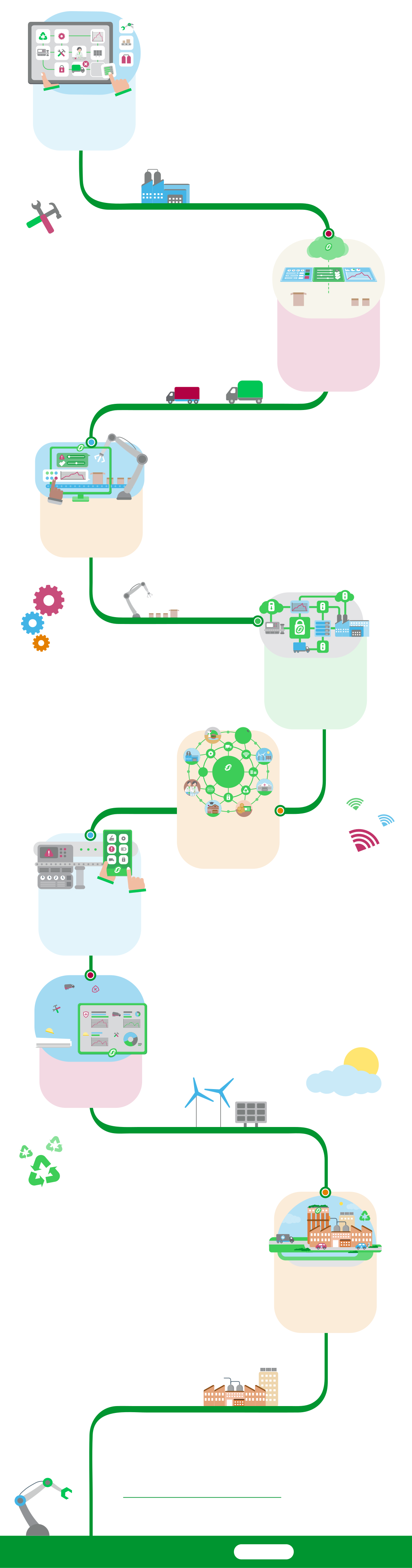
Decoupling automation software from hardware means operations can be built and easily updated with interoperable best-of-breed technologies. Think of it as the dawn of an industrial app store.
In addition, the deployment of tools such as digital twins, augmented reality, predictive maintenance, and machine learning are creating efficiencies and capabilities that we could only dream of a decade ago.
“Digitalisation is breaking down silos and providing a unified, real-time view of the entire business – enabling faster, more accurate innovation, decision making and delivering more agile and profitable manufacturing,” notes James Chae, VP, Industrial Automation, East Asia & Japan, Schneider Electric.
Along with the promise of greater efficiency, energy savings and cost reductions, this brave new world brings challenges.
Integration
Integrating the operations management of ever more complex manufacturing systems is essential to fully realise productivity gains. Industrial software is playing an increasingly key role, bringing together the diverse aspects of business operations and allowing manufacturing and process operations to be built out and updated with interoperable technologies throughout their lifecycle.
Another side of integration is the greater efficiencies delivered by operations-wide management through an end-to-end platform versus managing separate plants and sites on a piecemeal basis.
Digital from end point
to the cloud
An ecosystem of modular IIoT technologies and applications deployed from the shop floor to the top floor and beyond to collect, aggregate and turn data into insights and actions can return millions of dollars of improvements.
Integration is at the heart of EcoStruxure™, Schneider Electric’s open and interoperable architecture and platform that can facilitate the deployment and operation of secure, efficient flexible advanced manufacturing automation systems and beyond.
The benefits of such integration are already being felt at Singapore-headquartered Sanwa-Intec, a supplier of automotive components to manufacturers in Southeast Asia.
Sanwa adopted EcoStruxure at a model factory that came online in 2019, after consulting with Schneider Electric, iPlast 4.0 and other industry partners.
The company deployed integrated solutions, including Schneider Electric’s augmented reality offer EcoStruxure Augmented Operator Advisor, to deliver cost savings and efficiencies.
Augmented reality
Empowering operators with technology that helps them work smarter can reduce downtime, streamline operations and reduce maintenance time by up to 20%.
“We met with Schneider Electric late last year and it was very quick to have everything installed, despite the impact of COVID-19.
It’s very straightforward and easy to use; it really is plug-and-play and can be used with other software providers,” explains Sanwa-Intec's operations manager Anthony Yeow.
“The real-time monitoring of energy use for each machine alone saves 72kw/h per day.” Sanwa is set to replicate the setup of its model factory at its other facilities in Singapore, and then in its factories in China.
Multi-level cybersecurity
Safeguards humans and provides data and business integrity. Empowering the people, strengthening the processes and fortifying the technology to detect, reduce and prevent cyberattacks ensures all operate in a safe, reliable, and secure digital ecosystem.
Cybersecurity
Another issue that comes with the industries of the future is cybersecurity concerns due to increased connectivity of a range of devices and systems, and the related rising value of data.
EcoStruxure addresses cybersecurity challenges on multiple levels, enabling the solutions to adapt to evolving threats. This includes expedited remediations, patching and user-friendly mitigations, and continually addressing vulnerability threats and threat vectors.
Open digital ecosystems
Solve efficiency and productivity problems more quickly through collaboration and co-innovation leveraging open digital ecosystems and business platforms.
Skilling up
The tech skill shortage in the global workforce will be somewhat alleviated by the expansion of Industry 4.0 across other sectors.
The current talent shortfall is particularly pronounced in Southeast Asia, though the situation is far from uniform across the countries of the region.
The deployment of advanced industrial automation solutions and technologies can help alleviate skill shortages in some areas, but the transformations will also change the nature of some work and create new jobs requiring more advanced skillsets.
Digitized maintenance with apps and analytics
Using apps, analytics and services to identify potential breakdowns before they become an urgent issue can result in 30% maintenance cost savings on critical equipment.
Policymakers will need imagination and flexibility to arm the next generation with the right skills, including engaging in public-private initiatives to deliver on this.
Schneider Electric is already partnering with schools and colleges in Indonesia, Thailand, Vietnam and Singapore, “collaborating on curriculum design, change and helping to ensure the transfer of necessary skills,” explains Christophe Avrain of Schneider Electric’s Industrial Automation Business in Asia.
Sustainability
Another major driver of change in industrial processes is the push towards decarbonisation. The ability of industrial enterprises to put sustainability at the heart of operations will be a major predictor of success. The fact that the industrial sector accounted for 37% of total global energy use1 and 30% of all greenhouse gas emissions2 in 2018 shows how much there is to be done.
“Energy intensive industries understand they can no longer be indifferent when it comes to sustainability efforts, nor can they afford the operational cost of energy waste,” says Schneider Electric’s Chae. “Effective management of process efficiency and energy usage is essential to establishing both credible sustainability and financial viability.”
Digitized lean manufacturing
Optimizes production by replacing paper record keeping, contributing to around 15% increases in operational efficiency.
The drive for both environmental and operational sustainability is of particular relevance in Southeast Asia, where emissions and energy waste remains high in comparison to other regions. Solutions such as Schneider Electric’s EcoStruxure Power and Process can help reduce total expenditure, optimise operations, and reduce an organisation’s carbon footprint.
Greater use of data and analytics across the value chain of raw material and energy sourcing, logistics and manufacturing can improve overall operational efficiency and reduce waste. Similarly, the effective deployment and control of connected devices can prioritise resource efficiency and reduce instances of equipment failure, a significant source of energy waste.
Sustainability at the heart
of operations
Integrated management of process performance and electrical power consumption can result in 20% capex reductions, 15% decrease in downtime and 7-12% reductions in carbon footprint.
The Industries of the Future
Companies that successfully adapt to the myriad of changes will thrive well into the future. Effectively integrating automation, smart technology and sustainable systems help position industrial enterprises for economic success. Those that fail to keep pace with and effectively navigate these shifts will struggle to remain competitive in the new landscape.
1www.iea.org/reports/tracking-industry-2020
2www.ipcc.ch/site/assets/uploads/2018/02/ipcc_wg3_ar5_chapter10.pdf