World-leading Japanese non-touch technology helps keep us safe
In a short space of time, touch screen technology has gone from being a novelty to ubiquitous in commerce, healthcare, education and every other part of our daily lives. From mobile phone screens to ATMs, ordering at restaurants and countless business and industrial applications, touch screens have become accepted as a fast, convenient and secure form of digital communication.
As in many other facets of our lives, however, the coronavirus pandemic has caused huge disruption and widespread distrust of what we used to take for granted. Whereas in the past we would have had no hesitation in touching the screen of a bank cash machine or the buttons of an elevator, the virus has forced us to think again.
Fortunately, a number of Japanese companies were ahead of the curve even before the pandemic broke out and are pioneering technologies that eliminate the need to physically touch a screen to make a device follow the user’s instructions.
And with the hangover from coronavirus likely to linger for some years, these advances in human-machine interface will play a key part in the ongoing digital transformation of our society.
Alps Alpine reaching new heights

Tokyo-based Alps Alpine Co. started producing touch panel in the late 1990s - but recognized as early as 2018 that high-sensitivity capacitive sensors originally developed for the automobile industry could have alternative uses.
“We spoke to our customers and learned there were many scenarios in which people did not want to physically touch a button or screen,” said HAGIWARA Yasuji, HMI Project Group2 Manager. “Even before the coronavirus, some people were reluctant to touch buttons in an elevator, the function buttons in a public toilet or a security keypad.” Interest in Alps Alpine’s vision for touchless technology soared as soon as the scale of the coronavirus became apparent.
The company’s equipment can detect a user’s finger at a distance of up to 10cm and then comply with directions without the need for any physical contact.
Hagiwara lists the advantages. The risk of a person being exposed to an infectious disease is reduced and stress related to hygiene fears is diminished, while the technology also combats security-related crimes linked to a person’s fingerprint data.
Through exhaustive testing and refinements, Hagiwara’s team has been able to determine the optimum location for a sensor in any given application and devised easy-to-comprehend sounds and graphics that indicate a finger has been recognized and the device is operational.
User familiarity with the technology has proved to be a challenge, Hagiwara confirmed.
Once the public has overcome those initial reservations and realized the advantages of touch-free technology, Hagiwara is confident it will become commonplace.
It is very important that people do not believe that touch-less technology is difficult to use and therefore avoid using it, we have to be comfortable with it in our everyday lives.
Developing dynamic displays
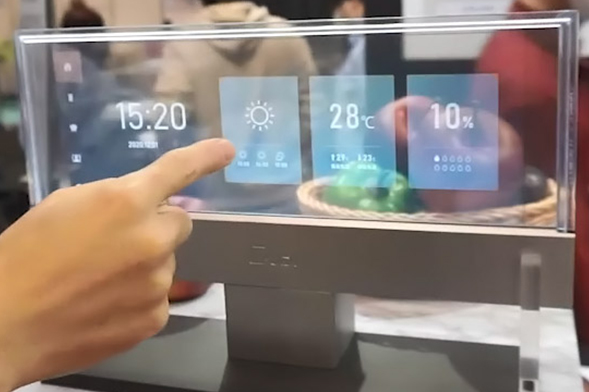
Japan Display Inc. has similarly been working on screens that do not require a user to physically touch them, a further enhancement of the company's cutting-edge technology used in mobile phone screens named "Pixel Eyes".
“The key development in our new screen lies in its transparency and thinness. By applying this new screen, but also as in that the sensor can receive commands from a finger that ‘hovers’ or if the user actually touches the screen,” said MIZUTANI Masuki, head of the New Business Development Division.
A significant advantage of this system, is that since the sensor is separate from the screen, it can turn a conventional screen into one which accepts commands without the need to touch it.
Consequently, customers do not have to replace an entire system in, for example, an elevator or a digital restaurant menu.
JDI has been working on screen technology for about a decade, initially for smart phones and car navigation systems, but anticipates this latest evolution will open up a range of new opportunities. And that has been “accelerated” by the pandemic, Mizutani said.
“Rather than individual users, we expect non-touch technology to be adopted in a wide range of public applications, such as elevators, ATMs, medical facilities and other businesses where hygiene is of the utmost importance, such as food-related companies,” he said.
As this is a system which will be mainly used in public applications, we feel the technology can contribute to better hygiene in society, that is even more important in countries where populations are ageing and we need to do everything that we can to help and protect the elderly
Three-dimensional, holographic advances
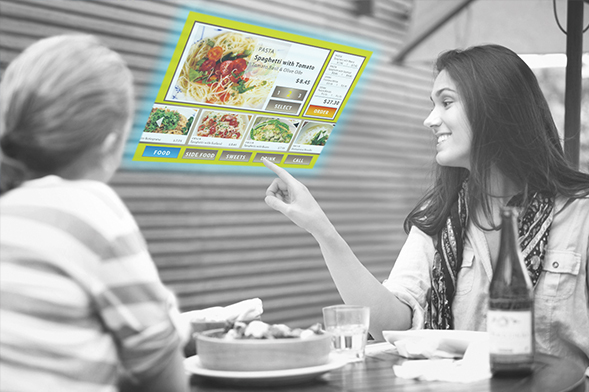
The technology developed by Asukanet Co Ltd.looks simple - but that first impression is deceptive.
What appears to be little more than a square of clear glass is in reality thousands of wafer thin slices that have been sandwiched together, with motion sensors enabling the screen to generate a holographic image “floating” above the device. A user is then able to manipulate the controls that appear as a hologram above the ASKA3D-Plate.
The system employs reflective technology which is so precisely machined that it is an excellent example of “made in Japan,” said OTSUBO Makoto, a specialist for the Hiroshima-based company.
“We began work on this technology about 10 years ago and we were already working on replacing touch-screen systems with holographic instructions before the coronavirus,” Otsubo said.
The concept was so advanced, however, that the company had to first create machinery to fabricate glass that is mere microns thick as none existed previously.
ASKA3D delivers a far clearer and brighter resolution than previously achieved, with an image that can be projected as much as two meters, said Otsubo.
“We are working with companies in a range of industries, including sensor manufacturers and system engineers, who then turn our system into a product that has applications, for example, in the medical sector, the automobile industry, digital signage, ticketing machines and so on,” he said.
As this is a system that will be mainly used in public applications, we feel the technology can contribute to better hygiene in society - and that is even more important in countries where populations are ageing and we need to do everything that we can to help and protect the elderly.
From ideas to innovation
At a time of global crisis, Japanese companies have once again risen to one of the key challenges facing mankind. Building on their existing knowledge and skills, these firms are devising futuristic solutions that will help to keep us all safer.
Screens that no longer require a user to physically touch them and holographic images that can be manipulated were not long ago the stuff of dreams. Now, they are about to further transform the way we live.